



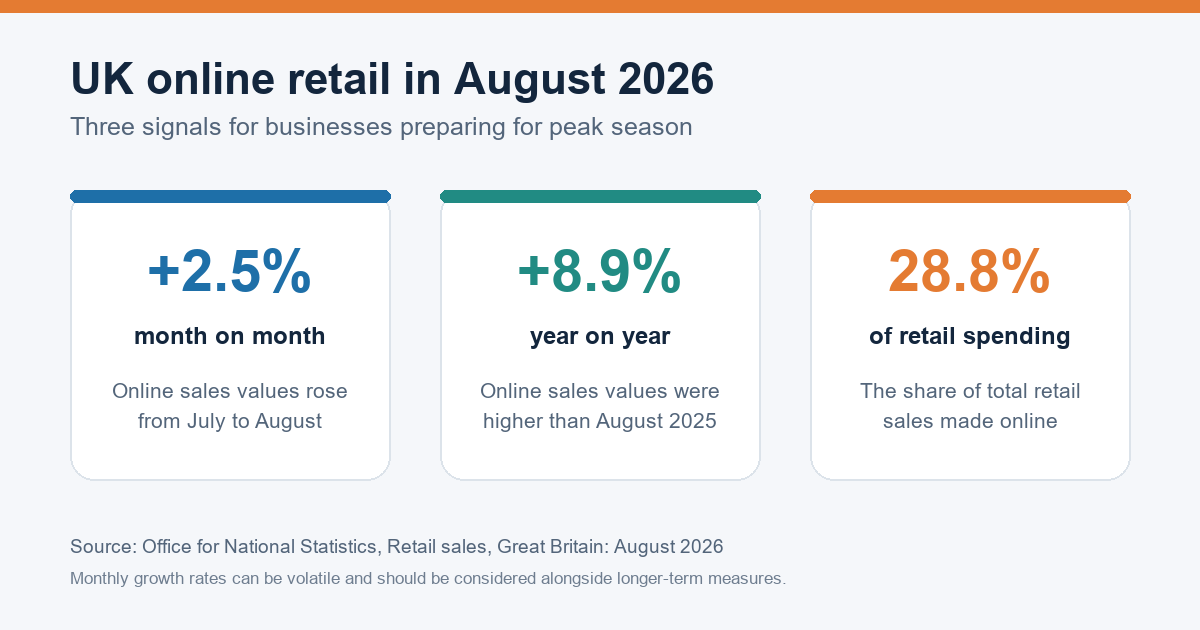
For UK retailers, the latest online shopping figures offer a timely reason to prepare with confidence. According to the Office for National Statistics (ONS), online sales values rose by 2.5% between July and August 2026 and were 8.9% higher than in August 2025. Online purchases also accounted for 28.8% of total retail spending.
That does not guarantee every business will see the same growth, and the ONS notes that monthly online sales figures can be volatile. But it does show that digital demand remains a major part of UK retail just as businesses enter the critical run-up to Black Friday and Christmas.
The positive message is simple: businesses do not need a vast warehouse or a complicated logistics department to get ready. A few practical improvements now can make it easier to process more orders, protect margins and give customers a dependable delivery experience when every day counts.
Peak season is a systems test, not just a sales event
Busy periods expose small problems very quickly. A few incorrect addresses become a pile of customer service queries. Packaging that is slightly too large adds unnecessary cost across hundreds of orders. Relying on one delivery option can leave a business vulnerable when a service is unsuitable for a particular parcel, postcode or deadline.
The best preparation is therefore not to predict the exact number of orders. It is to build a shipping process that can flex when demand is higher, lower or simply different from expected.
Eight ways to make your delivery setup peak-season ready
1. Forecast the workload using your own evidence
Start with last year's order history, then note any changes to your product range, marketing plans and sales channels. Record your likely daily order volume, busiest dispatch days, common destinations and the proportion of parcels that are small, heavy, long or fragile.
A simple low, expected and high forecast is often more useful than one ambitious target. It helps you decide how many packing stations, labels, boxes and collection slots you may need without overcommitting cash.
2. Measure the parcel after it is packed
Delivery quotes depend on the finished parcel, not the product alone. Measure and weigh a fully packed example of each common order type, including protective material and the outer box. Accurate details reduce the risk of surcharges and make comparisons more meaningful.
Review packaging at the same time. A smaller, well-fitted box can reduce wasted material, lower volumetric weight and take up less space in your stockroom. The goal is secure packaging with no unnecessary bulk.
3. Offer a small number of clear delivery choices
Customers usually benefit more from clarity than from a long menu. Consider a straightforward set of options such as:
- Good value: an economy delivery service for customers who can wait a little longer.
- Faster: an express option for urgent orders.
- Convenient: a suitable drop-off service or collection service where available.
Use realistic wording at checkout and make the distinction between your dispatch time and the courier's transit time clear. That small detail can prevent misunderstandings during the busiest weeks.
4. Avoid depending on a single delivery service
No one courier or service is the best fit for every parcel. Size limits, remote-area coverage, price and speed can vary. Interparcel lets businesses compare a range of delivery options in one place, helping you choose an appropriate service for each shipment rather than forcing every order through the same route.
It is also sensible to identify a backup option for your most important parcel types before you need it. A contingency plan is much easier to use when it has already been checked.
5. Remove repetitive work from order processing
Manual copying and pasting may be manageable on a quiet day, but it becomes slow and error-prone as order volumes rise. Interparcel Shipping Manager can import orders from connected selling channels, help create labels, flag potential address issues and keep tracking information together. There is no subscription or usage fee for Shipping Manager; businesses pay for the delivery services they book.
Set up integrations and test your normal workflow before peak orders begin. The aim is for everyone who helps with dispatch to follow the same repeatable process.
6. Publish honest cut-off dates and communicate early
A realistic promise is more valuable than an optimistic one. Work backwards from carrier schedules, your own processing capacity and the destination. Add a buffer for weather, traffic and exceptionally high network volumes.
Display ordering deadlines prominently on product pages, at checkout and in confirmation emails. Send tracking details promptly and explain what a customer should do if they need help. Proactive communication can reduce “where is my order?” contacts and build trust even when networks are busy.
7. Design the returns journey before orders leave
A sale is not complete when the parcel is dispatched. Clear returns instructions, a defined inspection process and a plan for putting suitable stock back on sale can protect both customer confidence and cash flow.
Check that your returns policy is easy to find and written in plain English. Internally, decide who approves returns, where parcels should go and how quickly refunds or exchanges will be processed.
8. Prepare international orders and customs data
If peak season includes overseas customers, review product descriptions, commodity codes, values and country-of-origin data now. Vague descriptions or missing information can cause delays at the border. Compare suitable European delivery services and wider international options, and make duties and taxes as clear as possible to the recipient.
Good customs data is not just paperwork. It is part of the delivery experience.
A ten-minute peak-season readiness check
Your business is in a stronger position if you can answer “yes” to these questions:
- Do we know the packed weight and dimensions of our most common orders?
- Do we have enough right-sized packaging and label supplies?
- Can we compare more than one courier or service when needed?
- Have we tested our order import, booking and label-printing process?
- Are our delivery promises and last-order dates realistic?
- Does every team member know how to handle an address problem or delayed parcel?
- Is our returns process ready for higher January volumes?
- Is our customs information complete for international products?
If several answers are “not yet”, that is useful information, not a failure. Tackle the highest-volume or highest-risk issue first, document the improved process and then move to the next.
Turn stronger online demand into repeat business
The latest figures are encouraging, but winning a busy-season order is only the first step. Customers remember whether delivery choices were clear, tracking was easy to follow and the parcel arrived as expected. A calm, flexible shipping setup can turn seasonal demand into reviews, recommendations and repeat purchases.
Interparcel helps UK businesses compare delivery services from multiple couriers, book collections or drop-offs and manage orders in one place. That gives small teams more control without needing to build a logistics operation of their own.
Ready to test your peak-season setup? Compare parcel delivery quotes with Interparcel, or set up Shipping Manager before the rush begins.
Frequently asked questions
What is peak season for ecommerce businesses?
Peak season is the period when retailers typically experience higher order volumes, particularly around Black Friday, Cyber Monday and Christmas. The exact dates and demand pattern vary by business, product and customer base.
When should a business prepare for Black Friday and Christmas shipping?
Preparation should begin several weeks in advance. Test courier options, packaging, order imports, labels, customer communications and backup processes before promotions start so problems can be fixed while volumes are manageable.
Can I use different couriers through Interparcel?
Yes. Interparcel lets you compare suitable delivery services from a range of couriers, so you can choose according to the parcel, destination, speed and price instead of relying on one option for every order.
Does Interparcel Shipping Manager charge a subscription fee?
No. Interparcel Shipping Manager has no subscription or usage fee. You pay for the parcel delivery services you book.
How can I reduce delivery problems during busy periods?
Use accurate packed weights and dimensions, validate customer addresses, select an appropriate service, package goods securely, publish realistic cut-off dates and send tracking information promptly. It is also useful to identify a backup delivery option in advance.
Source: Office for National Statistics, Retail sales, Great Britain: August 2026, published 18 September 2026. Online sales values are seasonally adjusted; monthly movements can be volatile.




 Facebook
 Twitter
 Instagram
 Linked In
 YouTube